
Solar Lighting CSR in Rural India: A Programme Design Guide (2026)
- Marpu Foundation
- 3 days ago
- 11 min read
This article reflects observations on solar lighting CSR programmes in rural India as of April 2026. Solar technology, government schemes, and CSR practice continue to evolve. This article is updated annually. Last updated: April 2026.
Solar lighting is one of the most-funded categories in Indian corporate CSR. It sits at the intersection of environmental sustainability, rural development, and community welfare, and it addresses genuine energy access challenges across many parts of rural India. For corporate CSR teams looking at Schedule VII clauses covering environmental sustainability and rural development, solar lighting offers a specific, deployable intervention with clear community outcomes.
Yet solar lighting CSR is also one of the categories where the gap between well-designed programmes and weakly-designed ones is widest. Programmes that install solar equipment without sustained community engagement, without maintenance planning, and without technical rigour often produce installations that stop working within two to three years. The equipment sits idle, the community loses the benefit, and the CSR spend produces short-term rather than sustained outcomes.
This article walks through how to design a solar lighting CSR programme that produces sustained outcomes: what the different programme types actually involve, the design considerations that separate strong programmes from weaker ones, the critical question of post-installation sustainability, how the programme fits within the CSR framework, common mistakes across the sector, and suggestions for setting the programme up well from the start.
It is written for the CSR head, the CSR Committee, the sustainability officer, and anyone thinking about running or improving a solar lighting programme within their company's CSR portfolio. The article is a practitioner-voice operational reference. It is not a substitute for the company's own CSR Committee review, technical engineering consultation, or implementation partner evaluation of specific programme decisions.
Important note: This article provides operational guidance on solar lighting CSR programmes based on observed Indian practice as of April 2026. It is informational guidance and does not constitute legal, financial, technical, or compliance advice. Solar lighting programmes involve technical decisions about equipment specifications, installation, and maintenance that require consultation with qualified electrical engineers, solar system integrators, and technical field teams. Every programme decision should be reviewed by the company's CSR Committee, technical advisers, and Legal counsel with reference to the specific programme context. Verify against current CSR regulations under Section 135 of the Companies Act 2013 and the Companies (CSR Policy) Rules 2014, and against relevant technical standards, before finalising the programme.
What Solar Lighting CSR Actually Includes
Solar lighting CSR is a broad category that includes several distinct programme types. Understanding the distinctions helps CSR teams design programmes suited to specific community needs.
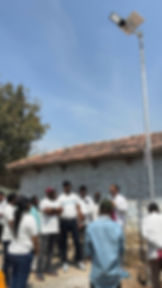
Solar street lighting: Installation of standalone solar-powered street lights along village roads, main streets, community pathways, or specific public areas. Each unit typically includes a solar panel, battery, LED lamp, controller, and pole
Solar home lighting: Provision of small solar systems for individual households, typically including a panel, battery, and one to four LED lamps. Suited to villages without reliable grid connection or with frequent outages
Solar lighting for schools: Installation of solar systems for schools, providing classroom lighting, staff room lighting, and often power for basic educational equipment. Enables evening study and reduces dependency on kerosene or unreliable grid supply
Solar lighting for community centres: Installation for anganwadis, health centres, panchayat offices, community halls, and similar shared community facilities
Solar lighting for specific groups: Programmes targeted at specific groups such as women's collectives, self-help groups, or agricultural cooperatives, providing lighting for their specific meeting or operational needs
Different programme types have different design requirements, different cost structures, different community engagement patterns, and different sustainability considerations. A programme choosing between them should be clear about what the target community actually needs rather than defaulting to the most common category.
Why Solar Lighting Works as a CSR Focus Area
Six specific characteristics make solar lighting a viable CSR focus area for many companies.
1. Genuine Rural Energy Access Need
Despite significant progress in rural electrification across recent years, many rural areas still face unreliable grid supply, load shedding, or specific access gaps for streets, community facilities, or lower-income households. Solar lighting addresses genuine need where the gap exists.
2. Clear Schedule VII Alignment
Solar lighting aligns clearly with Schedule VII clause iv on environmental sustainability including renewable energy, and clause x on rural development projects. Programmes are readily documented under either or both alignments.
3. Visible Community Impact
Unlike some CSR interventions, solar lighting produces visible community impact quickly. The lights work or they do not, and the community experience is immediate. This visibility supports reporting narrative and community relationship building.
4. Complementary to Other CSR Priorities
Solar lighting complements education CSR (through school lighting), women's empowerment programmes (through community centre and self-help group lighting), and rural livelihood programmes (through supporting evening economic activity). Companies with multiple CSR priorities can often connect them through solar lighting.
5. Measurable Outcomes
Programmes can measure specific outputs (number of installations, communities reached, hours of light provided) and outcomes (school attendance changes, evening economic activity, community safety perception) more tangibly than some other CSR categories.
6. Environmental Contribution
Solar lighting reduces dependency on grid electricity, kerosene, or diesel generators, contributing to emissions reduction. Where BRSR Principle 8 reporting is applicable for listed companies, the environmental dimension supports the disclosure narrative.
The Programme Design Considerations That Matter Most
Solar lighting programmes vary widely in quality. Five design considerations separate strong programmes from weaker ones.
1. Community Consultation Before Site Selection
Programmes that select installation sites through community consultation produce different outcomes than programmes that select sites through implementer or corporate preference alone. Communities know which streets have safety issues, which pathways are used at night, which households or facilities have the most acute need. Consultation surfaces this knowledge and produces installations the community actually values.
2. Technical Specification Appropriate to Community Context
Equipment specifications should match community context. High-capacity systems in low-usage locations produce waste. Low-capacity systems in high-usage locations produce failure. Appropriate technical specification requires actual site assessment and consultation with qualified electrical engineers or solar system integrators. Programmes that default to standardised specifications across all sites often produce mismatched outcomes.
3. Implementation Partner Technical Capacity
Solar installation requires technical capacity that not every CSR implementation partner has. Programmes should select implementation partners with demonstrated technical experience in solar installation, quality standards for equipment procurement, and field teams capable of installation and initial commissioning. Where the implementation partner lacks technical capacity, the programme should engage a specialist technical partner alongside the primary CSR implementation partner.
4. Quality Standards for Equipment
Solar equipment varies significantly in quality. Cheaper panels degrade faster, cheaper batteries fail sooner, cheaper controllers are less reliable. Programmes that specify quality standards for equipment procurement produce longer-lasting installations than programmes that optimise only for lower cost per unit. Quality specification is one of the most consequential technical decisions in programme design.
5. Community Involvement in Installation and Handover
Programmes that involve community members during installation and handover produce different sustained-use outcomes than programmes where installation happens without community engagement. Community members who understand basic operation, know who to contact for maintenance, and feel ownership of the installation tend to protect and use it better across years.
The Sustainability Question: The Sector's Biggest Weakness
The single most consistent weakness across solar lighting CSR programmes in India is what happens after installation. Batteries typically last three to five years and then need replacement. Panels degrade slowly across ten to twenty years. Controllers and LED lamps can fail earlier. Without a maintenance and replacement plan, installations become non-functional within two to three years.
Addressing sustainability requires deliberate design across several dimensions.
1. A Planned Maintenance Regime
The programme should include a defined maintenance regime covering periodic inspection, cleaning of panels, checking of connections, and monitoring of battery performance. The regime should specify who performs each activity, how frequently, and at whose cost.
2. A Battery Replacement Plan
Batteries will need replacement. The programme should plan for this from the start, either through a corporate commitment to fund replacement at year three or four, through a community fund contribution model, or through partnership with a longer-term implementation partner that maintains the installations.
3. Community Ownership and Contribution
Programmes where the community contributes to maintenance costs, has a designated maintenance committee, and treats the installations as community property tend to sustain longer than programmes where the community treats the installations as gifts from outside.
4. Local Technical Capacity Building
Programmes that train a small number of community members in basic maintenance, troubleshooting, and battery-changing procedures build local capacity that reduces dependency on external maintenance visits.
5. Long-Term Implementation Partner Relationship
Where the corporate CSR programme continues over multiple years, the implementation partner can maintain a relationship with the installations, conducting periodic inspection and coordinating repairs. Partnerships that end at Year 1 rarely produce sustained solar lighting outcomes.
Companies designing solar lighting programmes with a one-year horizon should be honest with themselves and with the community about the likelihood of the installations remaining functional after three to five years. Multi-year programme design, or partnership with implementers committed to long-term maintenance, significantly improves the probability of sustained functionality.
How Solar Lighting Programmes Connect to the Broader CSR Framework
Solar lighting programmes connect to several components of the CSR framework.
Schedule VII clause iv (environmental sustainability including renewable energy) provides the primary alignment for solar lighting
Schedule VII clause x (rural development projects) provides a secondary alignment, particularly for rural-focused programmes
The Annual Action Plan under Rule 5(2) documents the specific solar lighting projects for the year, including geographies, targets, and modalities
The CSR Committee oversees the programme's approval, review, and continuation
Impact Assessment under Rule 8(3) may apply to larger solar lighting programmes meeting the specific thresholds
The Utilization Certificate discipline applies to solar lighting programmes as to any CSR spend
The Board's Report under Section 134 documents the solar lighting activities and outcomes for the financial year
BRSR Principle 8 for listed companies covers the community outcomes and the environmental contribution of the programme
Where implementation partners are Section 8 Companies, Trusts, or Societies, current CSR-1 registration is required for the partner to receive CSR funding
Five Common Mistakes in Solar Lighting CSR
Across observed practice, five recurring patterns weaken solar lighting programmes.
1. Optimising for Installation Count Rather Than Sustained Function
Programmes that measure success by number of installations delivered often produce many installations that fail within a few years. Measurement should include sustained functional installations at Year 3 and beyond, not only Year 1 installation count.
2. Ignoring Community Involvement in Design
Programmes designed entirely within the corporate CSR team and implementation partner, without community consultation, often produce installations in locations the community would not have chosen. Community involvement in site selection and design is one of the strongest predictors of programme success.
3. Under-Specifying Equipment Quality
Programmes that specify equipment only by broad type ("LED street light with solar panel") without quality standards receive equipment that varies widely and often skews toward the cheaper end. Quality specification requires technical consultation.
4. No Maintenance Plan
Programmes without a defined maintenance regime and battery replacement plan are effectively designing for two to three years of function. Programmes with maintenance plans built in are designing for longer-term impact.
5. Treating Solar Lighting as a One-Year Programme
Solar lighting outcomes compound over multiple years of sustained function. Programmes designed and funded as one-year interventions rarely produce the sustained community impact that multi-year programmes can. Multi-year design is a design choice worth making deliberately.
Five Suggestions for a Strong Solar Lighting CSR Programme
The following suggestions reflect practice that produces stronger solar lighting programmes. They are observations, not prescriptions.
1. Design for Multi-Year Sustained Function
Programme design should treat Year 1 as the installation phase and Years 2 through 5 as the sustained function phase, with equal attention to each. Multi-year commitment to maintenance, replacement, and support significantly improves outcomes.
2. Invest in Technical Consultation Before Installation
Consultation with qualified electrical engineers and solar system integrators before finalising specifications produces better technical outcomes than specifications set within the CSR team alone. Technical rigour pays returns across the programme's life.
3. Build Community Ownership From the Start
Community consultation on site selection, involvement during installation, and clear community ownership of maintenance are the practices that separate installations that function for years from installations that fade quickly.
4. Specify Quality Standards for Equipment
Quality specification for panels, batteries, controllers, and lamps produces longer-lasting installations. The upfront cost is higher; the sustained value across years is significantly higher.
5. Plan for Battery Replacement From Day One
Batteries will need replacement. Planning for this in the initial programme design, either through corporate funding, community contribution, or partnership commitment, addresses the single most consistent failure point in solar lighting CSR.
A Note on the Limits of This Article
This article provides operational guidance on solar lighting CSR programmes based on observed Indian practice as of April 2026. It is informational guidance and does not constitute legal, financial, technical, or compliance advice.
Solar lighting programmes involve technical decisions about equipment specifications, installation, and maintenance that require consultation with qualified electrical engineers, solar system integrators, and technical field teams. The specific technical standards, government scheme guidelines, and CSR regulations applicable to any programme should be verified against current provisions before finalising the programme.
The programme types, design considerations, and suggestions in this article are starting references, not prescriptions, and should be adapted to the specific programme context, community needs, and technical requirements with professional consultation.
What This Article Is Actually Saying
Three things are worth holding onto.
1. Solar lighting CSR includes several distinct programme types with different design requirements. Street lighting, home lighting, school lighting, community centre lighting, and specific-group programmes each have their own considerations. The programme should be clear about which type it is delivering and why.
2. The single biggest weakness of solar lighting CSR is post-installation sustainability. Programmes that install without maintenance planning, without battery replacement provision, and without community ownership produce installations that fade within two to three years. Programmes designed for sustained multi-year function produce different outcomes.
3. Strong programmes are built through community consultation, technical rigour, and long-term design commitment. Community involvement in site selection and maintenance, quality specification for equipment, technical consultation with qualified engineers, and multi-year programme design together produce solar lighting CSR that genuinely sustains.
The companies that build solar lighting programmes well tend to be those that invest in technical consultation, involve the community from design onward, specify quality standards, plan for battery replacement from the start, and commit to multi-year presence. The compounding effect across years, in terms of community outcomes and reporting narrative, is meaningful.
Working With Marpu Foundation on Solar Lighting Programmes
At Marpu Foundation, solar lighting is one of the programme categories we operate across our network of 250+ corporate partnerships and 23+ Indian states. Our documentation and field practice for solar lighting programmes reflect the observations above.
For corporate CSR teams planning solar lighting programmes for FY 2026-27 and beyond, the ways we support the work include the following:
Programme design input: Contributing to programme design including site selection frameworks, technical specification considerations, community engagement approach, and multi-year sustainability planning
Multi-state operational reach: Enabling programmes across our 23+ state footprint including rural districts where solar lighting need is genuine and multi-year presence is feasible
Community engagement: Supporting community consultation, involvement in installation, and ownership building for sustained programme outcomes
Documentation discipline: Maintaining the activity-level, technical, financial, and Utilization Certificate documentation that supports corporate partners' statutory audit, Board's Report drafting, CSR-2 filing, and BRSR Principle 8 disclosure
Multi-year partnership orientation: Supporting solar lighting programmes designed as multi-year interventions rather than one-year deployments, drawing on the ongoing project provision under the CSR Rules
We hold current CSR-1 registration, 12A registration, and 80G registration, and our documentation supports corporate partners' CSR compliance across the annual cycle.
For CSR teams planning solar lighting programmes for the coming financial year, write to connect@marpu.org or visit marpu.org. Send a brief note on your target geographies, your community context, your programme scale, and your multi-year horizon, and we respond within two working days with programme design input, operational presence details, and a proposal aligned to your priorities.
For CSR teams designing solar lighting programmes with any implementation approach, the guidance above is the working reference. Invest in technical consultation, involve the community from design onward, specify quality standards, plan for battery replacement from Day One, and commit to multi-year presence. The programmes that sustain are the programmes designed to sustain.